What Is the Velcro Strap on a Fishing Shirt For?
Identify a fishing shirt’s rod-holder strap, tell it apart from sleeve tabs and utility loops, and check whether its placement fits your tackle routine.
Quick Answer
A small hook-and-loop strap or loop on the chest of some fishing shirts is intended to help hold a rod briefly while your hands handle another task. Its exact arrangement varies by shirt. Other similar-looking details may secure a rolled sleeve, close a pocket or provide utility storage. Identify the feature in the manufacturer's description before using it. A shirt-mounted holder is a convenience detail, not a substitute for properly supporting or securing fishing equipment.
As an Amazon Associate I earn from qualifying purchases. These links take you to Amazon, where purchases take place.
Three relevant shirts to compare
Examples for this guide. Check the exact garment and variation on Amazon.


In this field note
- What the manufacturer actually identifies
- Tell the chest holder apart from other small tabs
- Its purpose is a short pause in the sequence
- Check the arrangement before involving tackle
- Where the feature can be useful—and where it gets in the way
- Try access from both sides of the task
- Keep closures tidy between uses
- Let the strap be a secondary buying detail
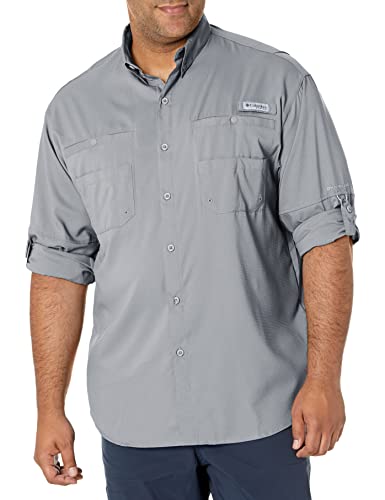
That little strap above a fishing shirt's chest pocket is easy to mistake for decoration. On some designs, it is part of a rod-holder arrangement intended to free your hands for a brief task. The important word is “some.” Fishing shirts also carry sleeve tabs, pocket closures and small utility loops, and they do not all serve the same purpose.
Before threading equipment through any fabric loop, identify what the manufacturer calls it. Placement provides a clue, but the product description is more useful than guessing from shape. A chest detail described as a rod holder has a different job from a tab that keeps a rolled sleeve in place. This guide helps you distinguish them and decide whether a chest holder would make your routine easier.
What the manufacturer actually identifies
Columbia's current Bonehead short-sleeve page identifies a left-chest rod-holder loop and separate utility loops. That distinction matters: the garment includes more than one small attachment detail, and the brand does not describe them as interchangeable. The presence of several loops is a reason to check their individual functions, not to use whichever is easiest to reach.
The Bonehead short-sleeve product page lets you inspect the corresponding marketplace example. Compare the visible chest arrangement with the version you own or intend to buy. If a photograph or listing does not explain the detail, ask the manufacturer about the exact model. The broad term “fishing shirt” is not enough to tell you how a particular holder is meant to operate.
Tell the chest holder apart from other small tabs
| Detail | Where you commonly inspect it | What to verify |
|---|---|---|
| Rod-holder strap or loop | Chest area | Explicit manufacturer identification and intended use |
| Roll-up sleeve tab | Sleeve, often with a fastening point higher up | How it retains the rolled fabric |
| Pocket closure | On a flap or pocket opening | Whether it closes storage rather than supporting equipment |
| Utility loop | Near pockets or another accessible position | Which items the maker says it accommodates |
A roll-up sleeve tab should make sense when the sleeve is folded. It connects the folded material to a fastening point so the roll can remain in place. A pocket's hook-and-loop patch should align with its matching closure. A rod-holder detail has its own arrangement. Taking a moment to follow where each part connects usually clarifies the difference without pulling, stretching or improvising.
Do not assume that every hook-and-loop fastening is branded Velcro. The familiar name is often used conversationally for that style of closure. When comparing products, terms such as “rod holder,” “rod-holder loop” or “utility loop” may lead you to the relevant description more effectively than searching only for “Velcro strap.” A different fastening method does not necessarily imply a different intended task.
Its purpose is a short pause in the sequence
Think of the holder as a way to organize a brief transition. You might need both hands while handling a small tackle item, and you would prefer the rod to remain close rather than setting it in an inconvenient place. A shirt detail can assist that moment when used as intended and when the equipment is otherwise appropriately supported.
It should not be treated as a load-rated rod rack. Do not infer a weight limit, suitability for every rod or ability to withstand a pull simply because the loop is stitched to the shirt. Neither of the product examples here provides grounds for those universal claims. The sensible boundary is the manufacturer's described convenience function, with attention to the particular equipment and surroundings.
This distinction also changes what you look for when shopping. A useful holder needs reachable placement and a fastening you can operate comfortably. It does not need to be large merely to look robust in a photograph. A detail that interferes with your normal hand path or sits behind another piece of equipment can be inconvenient even if it is securely sewn.
Check the arrangement before involving tackle
Begin with the shirt empty and the fastening closed normally. Identify the opening, matching closure and fabric attachment points. Look for loose stitching, distortion or an uncertain route through the holder. If the detail is damaged or you cannot establish its intended function, avoid experimenting with a valuable rod to work it out.
Next, put the shirt on with the other equipment you ordinarily wear. A chest strap, vest or sling can cover the loop. Reaching across the body may be straightforward when standing without a bag and awkward when wearing your usual setup. The relevant question is whether you can reach and release the detail calmly without rearranging the rest of the outfit.
For another chest-holder example, inspect the Columbia Tamiami II long-sleeve listing on Amazon. The linked marketplace title includes “Discontinued”; that wording describes the listing and does not establish that all remaining items are unavailable. Compare its photographs and edition carefully with Columbia's current Tamiami II description, which also identifies a rod-holder detail.
Where the feature can be useful—and where it gets in the way
A standing task with clear chest access
When the front of the shirt is unobstructed, a chest holder may be within an easy reach. That makes it a plausible convenience for an angler who already likes a utility shirt and regularly pauses to manage small tackle. The benefit is keeping a familiar workflow close to the body. It does not need to become a feature you use for every adjustment.
A shirt beneath a vest or pack
A useful feature can disappear under another garment. If you spend most of the outing with the chest covered, a rod-holder loop may contribute little to your decision. Trying to force access through straps or layers can defeat its convenience. Keep the rest of your equipment arranged as intended; the shirt should work with that arrangement rather than requiring it to change.
A task in a confined position
Seated space and nearby objects can affect what is practical. A holder that is reachable while standing may put equipment in an awkward position when you sit or lean. Evaluate the geometry of the entire rod and reel, not just the small part near the shirt. A convenient chest attachment does not resolve where everything else needs to go.
In each case, the decision is modest: does this detail help one task you actually perform? If the answer is no, there is no reason to treat it as a missing essential. A plain performance crew can still be a suitable fishing shirt. The button-front versus performance comparison addresses that larger format choice.
Try access from both sides of the task
A chest detail has a fixed position, while your hands change jobs. Consider which hand normally holds the rod and which reaches for tackle. Then, with no equipment attached, practice reaching for the closure with the hand that would actually be available. A comfortable reach with your favored hand is not enough if that hand is occupied at the relevant moment.
Check the path rather than simply touching the strap. Can you find the opening, operate its closure and move your hand away without catching a pocket flap? If you need to look down closely every time, ask whether the feature would simplify the task you had in mind. A familiar bag compartment or a supported resting place may fit the sequence better.
Now repeat the reach with the small pocket item involved. Keep the holder empty during this rehearsal. The aim is to see whether accessing the loop and retrieving the item compete for the same space. For example, a bulky pocket load may make it harder to approach a nearby closure. Reducing that load can improve access without changing the shirt.
The Tamiami II listing details and Bonehead long-sleeve listing offer layouts to inspect while considering that hand sequence. Decide which front arrangement suits the way you already work. The useful feature is one you can reach calmly; a detail that requires a new, awkward series of motions has little advantage over leaving it unused.
Keep closures tidy between uses
An open fastening can catch on nearby fabric or accumulate debris. Columbia's general apparel-care guidance recommends securing garment fasteners to reduce snagging during washing. Apply the garment's own care instructions, and inspect the small attachment before the next use rather than assuming that a shirt which looks clean has no damaged stitching.
If a closure stops fastening as expected, do not compensate by pulling it tighter around equipment. Identify whether it is obstructed, worn or detached and seek appropriate repair guidance. A change to the loop's shape or stitching may alter its operation. There is no reason to turn a small convenience problem into a test of how much force the shirt can tolerate.
Let the strap be a secondary buying detail
For most shoppers, the whole shirt still needs to fit and feel right. A correctly placed rod holder cannot compensate for sleeves that restrict movement or pockets you cannot reach. Begin with a comfortable utility shape, then decide whether this particular detail improves it. The button-front collection is the relevant place to compare those designs.
If the traditional pocketed layout interests you, check the Bonehead short-sleeve options on Amazon and verify the chest details on the selected version. Then use the feature guides for related questions. A rod-holder strap is most valuable when it quietly simplifies a brief task; its presence should not encourage unsupported loads, improvised uses or an otherwise unsuitable shirt purchase.
Frequently asked questions
Is every small loop on a fishing shirt a rod holder?
No. Some loops are utility details, and other tabs close pockets or retain rolled sleeves. Check the manufacturer description for the exact garment.
Can I use the shirt strap as a permanent rod carrier?
Do not assume that. The examples here describe a brief hands-free convenience, without establishing a universal load rating or permanent carrying function.
Do short-sleeve fishing shirts have rod holders?
Some do. Columbia identifies one on its current Bonehead short-sleeve model, but sleeve length alone does not tell you whether another shirt has the feature.
Final Verdict
Identify the detail before using it. A manufacturer-described chest rod holder can help with a short hands-free pause, while similar-looking tabs may serve completely different purposes. Check access with your normal outfit, confirm the exact model and keep equipment properly supported. If the feature is covered by a vest, awkward to reach or unnecessary for your routine, do not make it a purchasing requirement. A useful shirt comes first; a small holder is an additional convenience. Its stitching and closure do not establish a universal weight limit or permission to use it as a permanent carrier.
Explore the matching collections
Take the next step
Compare your shortlist or explore more features & design.
Revisit the first shirt on Amazon ↗Related field notes
Columbia Tamiami II vs Bonehead: Polyester Utility or Cotton?
Compare Columbia Tamiami II long sleeve and Bonehead short sleeve by verified fabric, fit, pockets, care, and the sleeve difference that shapes the choice.
Read the field note →How to Wash Fishing Shirts and UPF Clothing
Wash fishing shirts and UPF clothing with a label-first routine for stains, fasteners, detergent, rinsing, and drying across different fabrics.
Read the field note →Choosing Fishing Shirts for Hot Weather
Choose a fishing shirt for hot days by comparing airflow, coverage, fit and wet-fabric comfort, with practical checks for humid weather and layered gear.
Read the field note →Columbia Fishing Shirt Sizing: Which Models Run Roomy?
Read Columbia fishing shirt fit notes by model, distinguish relaxed from regular cuts, and check standard, tall and older listings before choosing.
Read the field note →