Should You Use Fabric Softener on Fishing Shirts?
Learn when to skip fabric softener on fishing shirts, how to interpret care instructions, and what to check after an accidental softener wash at home.
Quick Answer
Skip fabric softener by default on performance fishing shirts unless the exact garment instructions explicitly allow it. Softeners and dryer sheets can interfere with moisture-wicking treatments, and a softer feel does not prove a shirt is cleaner. Read the detergent label too, because conditioning ingredients may be included in a combined product. After an accidental use, resume label-approved washing without softener rather than assuming the shirt is ruined.
As an Amazon Associate I earn from qualifying purchases. These links take you to Amazon, where purchases take place.
Three relevant shirts to compare
Examples for this guide. Check the exact garment and variation on Amazon.


In this field note
The useful question is what the shirt needs to do
A fishing shirt can be comfortable because of its fit, a supple fabric, an airy construction, or the way it handles moisture. Fabric softener addresses a different goal: changing the laundry's feel. It is therefore worth asking why you are adding it before making it part of a performance-shirt wash. If the shirt already feels comfortable when clean and dry, an extra conditioning step may solve no actual problem.
For moisture-wicking clothing, there is a concrete reason for caution. Patagonia's explanation of wicking additives says waxes and softeners in some laundry products can impede wicking chemistry. This is manufacturer guidance about a functional interaction, not evidence that every softener instantly ruins every fishing shirt. The practical choice is to leave out optional softener unless the garment maker gives compatible instructions.
A shirt labeled only as a casual cotton fishing tee may present a different care decision from a treated performance knit. Even then, do not decide from fiber alone. Prints, blended fibers, finishes, and construction can add restrictions. The exact shirt label is the starting point, and the care information for its actual style is the next source when the label is unclear.
Read the laundry products as well as the garment
People often say they do not use softener because they never pour liquid into the softener compartment. That does not describe the whole laundry routine. A detergent may combine cleaning and conditioning, a dryer sheet may add a finish during drying, and a laundry service may use standard additives without asking. Check all the products that contact the shirt, especially when a new residue or feel appears after a change in routine.
| Item in the routine | Question to ask | Practical response |
|---|---|---|
| Liquid fabric conditioner | Does the garment permit it? | Omit it when permission is absent or unclear |
| Dryer sheet | Does it add a softening finish? | Apply the same caution as liquid softener |
| Combined detergent product | Does its label include conditioning ingredients or claims? | Choose a compatible plain detergent when needed |
| Shared washer or laundry service | Are additives included automatically? | Request the shirt's care instructions explicitly |
| Stain or odor additive | Is it approved for this garment and purpose? | Use only when the actual problem calls for it |
Do not treat every scented product as softener, or every fragrance-free product as automatically compatible. Scent and function are different label details. Likewise, a product marketed for athletic clothes still needs to match the garment and machine instructions. Select for the job you have: normal soil removal, a specific stain, or another identified problem. Avoid adding several products just because each promises a fresher wash.
If someone else launders your shirts, leave a short instruction with them: use the garment's allowed wash and dry settings, and omit fabric softener and dryer sheets unless permitted. That is more actionable than describing a shirt as technical. For a multi-person household, keeping fishing tops together can make the routine easier, provided their labels allow the same cycle.
Do not turn one brand's rule into every shirt's rule
Patagonia's care guidance generally discourages fabric conditioners and dryer sheets for its products. AFTCO's outerwear care instructions also address avoiding softener, but those directions belong to technical outerwear. They do not establish that every AFTCO shirt needs a specialist waterproof-shell cleaner. A rain shell and a fishing tee can have different finishes and different laundry requirements.
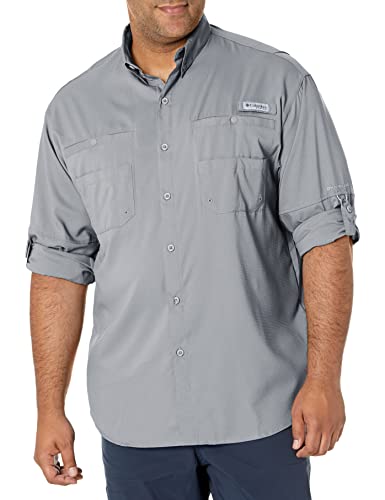
Columbia illustrates another important distinction. Its current Tamiami II long-sleeve page and Bonehead short-sleeve page list different care permissions. That does not answer every softener question for those garments, but it does show why a single rule based on the PFG name is inadequate. If softener is not addressed, omitting it is a straightforward choice while you seek clarification.
The Tamiami II product overview is useful for identifying the listed long-sleeve garment, while the Bonehead overview identifies a separate button-front example. The product cards here are care comparisons, not recommendations to purchase a replacement after one laundry mistake. A shirt's exact label remains more relevant than a broad claim about its brand.
If softener has already been used
Do not discard the shirt or declare its features permanently lost. First establish what happened: one dryer sheet, a normal liquid-softener dose, a concentrated spill, or repeated use over many washes. A concentrated spot deserves different attention from a shirt that merely went through the household's usual cycle. Check for visible marks and note whether the garment feels coated, unusually slippery, or otherwise different after drying.
For a washable shirt, return to the allowed wash routine using a compatible detergent without added softener. Follow the dose and rinsing directions. If the garment or detergent maker recommends an additional rinse for residue, use that instruction; do not assume that an unlimited series of washes is necessary. Inspect the result before deciding on another treatment. This is a conservative recovery approach, not a promise to restore a measured level of wicking or UV protection.
The Huk Icon X crew listing on Amazon identifies one performance-shirt example. If you own that version, use its own care instructions when asking about accidental softener use. Current Icon product information may concern a revised garment, so include a label photo or style identifier rather than relying on the short model name alone.
Avoid an improvised stripping recipe
Vinegar, baking soda, dish detergent, and very hot soaking are common suggestions for laundry buildup. A familiar household ingredient is not automatically suitable for a treated fishing shirt. Do not combine products, override temperature limits, or use a dishwasher-style degreasing approach because the fabric feels waxy. Ask the garment maker for a compatible residue-removal method if an ordinary approved wash does not help.
Keep any detergent spill or softener spot separate from the general question of performance. A visible mark needs a stain-treatment decision, including a hidden-area test. A shirt that simply feels different needs a calmer assessment after normal cleaning. The distinction prevents you from applying concentrated treatment over the entire garment when only one small area needs attention.
Solve stiffness and static at their source
If the shirt feels stiff, consider when that changed. Did you start using more detergent, pack it while damp, hang it with a folded collar, or wash a tiny load with a full-load dose? Check these ordinary causes before adding conditioner. Use the detergent maker's dosing instructions for the machine and load, and make sure the shirt can rinse and move appropriately within its permitted cycle.
For static after drying, review the label's drying instructions and whether the shirt stays in the dryer longer than necessary. Removing a garment promptly can also reduce the temptation to run another hot cycle just to remove wrinkles. If air drying is permitted, it is an option to try. Dryer balls are not a universal answer either: they still involve mechanical contact, and the garment must be suitable for tumble drying.
If the problem is a stiff collar or a pronounced crease, softener is an indirect solution at best. Reshape the shirt after washing and consult the wrinkle-removal guide for permitted finishing methods. If the problem is odor, use the odor guide. Giving each problem its own treatment is more useful than making every wash more complicated.
For repeated problems, keep a brief laundry note recording the detergent, dose, cycle, drying method, and whether any additives were used. Change one compatible part of the routine at a time. If you change every product and setting together, it becomes difficult to identify what helped. This is particularly useful when shirts are washed in several places during a trip and only one wash produces an unusual feel.
What you can and cannot judge at home
Comfort is worth observing. Note whether the shirt feels normal against skin and whether visible residue has disappeared. Those observations help decide whether to contact the manufacturer. They do not measure UPF, antimicrobial activity, stain repellency, or any other laboratory-style performance claim. Do not use a splash of water on the shirt as proof that all original features have returned.
Similarly, an accidental softener wash does not establish a precise new UPF value. ARPANSA's clothing guidance notes that protection can be affected by factors including wear and chemical exposure. It does not provide a household formula for subtracting UPF after a laundry mistake. If sun protection is a central reason you use the shirt and its condition is uncertain, seek guidance for that exact garment and use other appropriate coverage meanwhile.
Keep the everyday routine simple
Build your normal wash around the label, a suitable detergent, appropriate dosing, and the permitted drying method. Reserve extra products for identified problems. When browsing long-sleeve fishing shirts, care instructions are worth checking alongside sleeve length and fit, especially if you share laundry facilities or use hotel services. An uncomplicated routine is easier to follow consistently on a trip.
You can review the Bonehead short-sleeve listing on Amazon as a contrasting garment form, but choosing a cotton-style button-front does not remove the need to check its actual label. Return to the care hub for the full laundering sequence. Softener is one optional decision inside that routine; on performance fishing tops, leaving it out is usually the easiest conservative starting point.
Frequently asked questions
Are dryer sheets different from liquid softener for this decision?
Both can introduce softening ingredients. Apply the garment instructions to the whole routine rather than checking only the washer dispenser.
Did one accidental softener wash ruin my shirt?
Not necessarily. Resume label-approved washing without softener, inspect the result, and ask the maker if residue or a change in feel remains.
Can I test whether the UPF changed after softener use?
A home feel or water-drop test cannot establish a UPF rating. Ask the manufacturer about the exact garment and avoid inventing a new rating.
Final Verdict
For a performance fishing shirt, omit optional softener unless the garment instructions permit it. Check dryer sheets and combined laundry products too, because the choice extends beyond the washer dispenser. If a shirt feels stiff, smells, or has a visible mark, identify that problem and treat it directly with an allowed method. After accidental softener use, a normal compatible wash is a more sensible starting point than aggressive stripping or immediate replacement. Keep expectations measured: restored comfort is useful, but it is not a laboratory verification of every feature printed on the product page.
Explore the matching collections
Take the next step
Compare your shortlist or explore more care & durability.
Revisit the first shirt on Amazon ↗Related field notes
How to Get Wrinkles Out of Fishing Shirts
Get wrinkles out of fishing shirts with label-safe drying, careful pressing, and travel packing tips for woven shirts, performance knits, and logos.
Read the field note →How to Remove Fish Blood Stains from Fishing Shirts
Remove fish blood from fishing shirts with cold-water first steps, fabric-safe pretreatment, and a check-before-drying routine for fresh or dried stains.
Read the field note →What Are Fishing Shirts Made Of?
Learn how fishing shirt fibers, knit or woven construction, stretch, and finishes work together—and which details to verify on the garment label.
Read the field note →Columbia Tamiami II vs Bonehead: Polyester Utility or Cotton?
Compare Columbia Tamiami II long sleeve and Bonehead short sleeve by verified fabric, fit, pockets, care, and the sleeve difference that shapes the choice.
Read the field note →