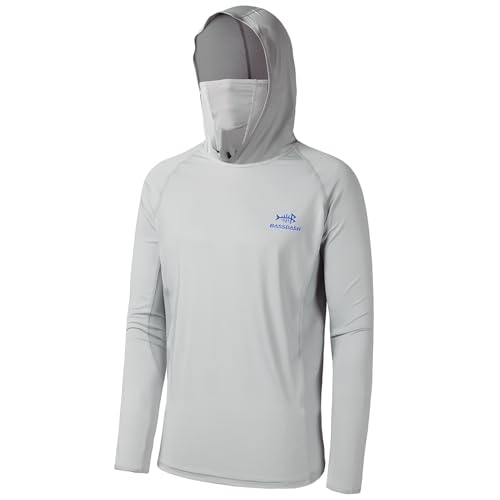
BASSDASH
Men's Neck Gaiter Fishing Hoodie
Long sleeve · Listed UPF 50+
Details & considerationsView on Amazon ↗Check built-in fishing shirt masks for face coverage, head movement, eyewear fit and comfort, with clear distinctions between hoods, gaiters and masks.
A built-in fishing-shirt face mask can keep a face-covering panel attached to the garment, but convenience depends on its shape and fit. Check how it sits around the nose, cheeks and neckline, whether you can turn your head comfortably, and how it works with your glasses and hood. A hood alone is not a mask. Verify the exact design and UPF claim, and do not treat a sun-covering panel as a respirator or certified protective face covering.
As an Amazon Associate I earn from qualifying purchases. These links take you to Amazon, where purchases take place.
Examples for this guide. Check the exact garment and variation on Amazon.
Long sleeve · Listed UPF 50+
Details & considerationsView on Amazon ↗Long sleeve · Listed UPF 50+
Details & considerationsView on Amazon ↗A face panel attached to a fishing shirt solves one small organizational problem: the covering is part of the garment rather than another loose item to locate. Whether it solves the larger comfort problem depends on where the panel sits, how it moves with your head and what happens when you lower it. Those details deserve a closer look than a front photograph with the mask perfectly arranged.
Start with the situation in which you expect to use it. Do you want coverage available for a brief exposed stretch, or do you expect to wear the panel for much of the outing? Will you also wear glasses, a cap and the hood? A design that works in one simple combination can become awkward when every part is used together.
Listings use “mask,” “face cover” and “neck gaiter” in overlapping ways. The garment may have a raised panel, a tube-like section at the neck or another arrangement that works with its hood. Do not assume all of these names describe the same construction. Find photographs showing the panel raised, lowered and viewed from the side.
The BASSDASH men's neck-gaiter hoodie names a mask in its title, making it a relevant example to examine. The baleaf men's face-mask sun hoodie also states the feature explicitly. Those titles are useful starting points, but they do not establish how either opening fits a particular face or whether one shape is more comfortable than the other.
A hood without a face panel is a different design. It may cover part of the head and neck while leaving the face exposed. If the integrated panel is the reason for shopping, do not rely on the word “hoodie” or a photograph where the model's face is partly hidden. The listing needs to identify the actual component.
Look at the panel's top edge, its sides near the cheeks and the point where it meets the shirt. Check what remains exposed when you turn your head or look down. A panel can shift, and a hood can pull on another part of the neckline. The relevant coverage is the position you can maintain comfortably during ordinary movement.
Pelagic's current women's Exo-Tech description provides a manufacturer example of a shirt explicitly combining an integrated face mask and ventilation. That identifies the kind of construction to look for; it does not prove complete facial coverage or establish the specifications of a different men's model. Be especially cautious with broad phrases suggesting protection in every direction.
The ARPANSA clothing guidance explains that UPF concerns covered skin and that stretch, wetness and wear can reduce protection. A number stated for a shirt does not fill gaps left around the panel. Read the exact garment claim and inspect the design separately, using the UPF checklist if the wording is unclear.
The face panel is connected to a garment that moves with your shoulders and arms. If the shirt is too short or restrictive through the upper torso, reaching forward may pull at the neckline. If the hood is tight when raised, it may change the tension on the mask. Evaluate those connections instead of adjusting only the panel's top edge.
Put on the shirt and let it settle with the hood down. Raise the panel without stretching it aggressively into place. Then turn your head left and right, look down toward your hands and return to a relaxed position. If it slips, pinches or pulls elsewhere, identify which part moves first. The answer may be a different panel shape rather than a larger overall shirt.
| Check | What you want to learn | Reason to pause |
|---|---|---|
| Head turn | Whether the panel follows comfortably | It pulls the neckline or rides into the eyes |
| Looking down | How fabric gathers below the face | The fold feels bulky or restrictive |
| Arms reaching forward | Whether torso movement tugs the panel | The mask becomes uncomfortable during ordinary reach |
| Panel lowered | Where unused fabric rests | It crowds the neck or interferes with another layer |
Add your cap and glasses if you normally wear them. Raise the hood, then repeat the head movements. Look at the overlap among cap, hood and panel. You should not have to hold one component in place continually to make another work. A successful combination lets you use the garment without constant rearrangement.
Glasses deserve their own check. Fabric may sit close to the frames or alter how they rest on the face. Notice whether movement pushes the panel toward the lenses or changes your comfortable view. Do not assume a particular shirt will prevent eyewear fogging unless there is suitable evidence for that specific claim; individual fit and conditions still matter.
The BASSDASH men's mask hoodie on Amazon is a useful place to inspect the raised and lowered arrangement before choosing a version. Look for a side view that explains the panel's connection to the hood. If the images never show the design lowered, that is a reasonable detail to clarify before buying.
Try the panel while relaxed and during the kind of gentle movement you use for a fitting check. If it feels uncomfortable or interferes with easy movement, lower it and reconsider the design. There is no benefit in forcing a garment component to stay in place when its fit is wrong for you. Choosing another arrangement is a normal part of selecting clothing.
The fabric near the face may also feel different from fabric on the torso, especially when damp. Without hands-on use, product copy cannot tell you exactly how that will feel. You can still inspect seam placement, available room and where the lowered panel rests. These concrete questions are more useful than accepting an unsupported promise that a mask stays comfortable all day.
Keep the function clear. A sun-covering panel on a fishing shirt is not automatically a respirator, filtration device or certified workplace face covering. Its marketing category does not establish those uses. The reason to consider it here is attached clothing coverage and convenience, within the exact garment's stated design.
Most people will not want the panel raised for every part of every outing. Think through drinking, talking, eating and putting on an outer layer. You need an arrangement that can be moved out of the way comfortably and then returned to its intended position. The question is not how quickly someone in a demonstration can do it, but whether the motion makes sense for your routine.
Check whether lowered fabric forms a thick fold at the neck. That fold may meet a jacket zipper or sit beneath another collar. It may also change how the hood lies against the back. If you plan to use the mask only occasionally, comfort in the lowered position may be the more important criterion because it occupies more of your wearing time.
This is where an integrated design has a real tradeoff. The panel is harder to forget, but it remains attached even when you are not using it. You cannot assess that tradeoff from the raised-mask photograph alone. A separate accessory may offer flexibility, while an integrated one reduces loose pieces; neither format wins for everyone.
The BASSDASH FS23W women's hoodie lists both a face mask and thumbholes. Each needs a separate fitting check. A comfortable face panel does not guarantee sufficient sleeve length, and a good cuff does not establish a suitable hood. Our thumbhole guide covers the sleeve question without asking the mask to solve it.
Likewise, more ventilation does not necessarily establish a particular cooling performance. Locate any openings and read the model description. A ventilation detail elsewhere on the torso may have little to say about the feel of the fabric over your face. Keep each product claim attached to the component it actually describes.
Read the care label for the entire shirt, including any instructions relevant to special finishes or trims. Do not apply a separate accessory's washing procedure simply because the panel resembles a neck gaiter. The attached design means the face section and shirt are cleaned as the manufacturer directs for that garment. Our washing guide explains the label-first approach.
Before ordering, check the selected size, model and photographs together. A marketplace page may offer several versions, and a change in the selected option can matter. If the face-panel construction is not clear, ask a question about that exact version rather than relying on reviews of an unspecified related shirt.
Inspect the baleaf face-mask hoodie listing on Amazon as another explicitly named example. Compare its arrangement with the BASSDASH designs, focusing on the mask-to-neck connection and the views available. Avoid declaring a winner from brand name or feature count when the deciding issue is personal fit.
The face-mask collection gathers relevant starting points, while the feature guides help separate hood, sleeve and ventilation choices. An integrated panel is worthwhile when it stays comfortable through normal movement and rests unobtrusively when lowered. That practical fit is more useful than a dramatic coverage slogan.
No. A hood and a face-covering panel are separate components. Look for an explicit description and photographs of the exact design.
Not automatically. Panel shape, neckline and hood tension can matter independently of chest size. Check the full garment fit before changing sizes.
Do not assume that function. A sun-covering garment panel does not establish filtration performance or respiratory-protection certification.
Choose an integrated mask by how it works with your face, neckline and headwear in both positions. Raise it, turn your head, reach forward, then lower it and check where the fabric rests. Confirm the exact design and rating without extending a coverage claim to exposed areas or treating the panel as specialized respiratory equipment. The attached format can be convenient, but it also means carrying the panel when it is unused. If both raised and lowered use feel straightforward, it is a feature worth considering; if either requires constant adjustment, a different design may suit you better.
Compare your shortlist or explore more features & design.
Revisit the first shirt on Amazon ↗Choose between a fishing hoodie and crew neck by checking cap fit, neck coverage, casting movement and how each works with your other clothing.
Read the field note →Learn how fishing shirt thumbholes affect sleeve position and hand coverage, how to check wrist tension, and when an ordinary cuff may suit you better.
Read the field note →Check women’s fishing shirt fit through the bust, hips, sleeves, and seated reach. Use body charts and movement tests to compare cuts confidently.
Read the field note →Find better value in fishing shirts by comparing useful features, fit, purchase terms and care, without relying on temporary prices or discount claims.
Read the field note →
