Hooded vs Crew Neck Fishing Shirts: Choose Your Coverage Setup
Choose between a fishing hoodie and crew neck by checking cap fit, neck coverage, casting movement and how each works with your other clothing.
Quick Answer
Choose a hooded fishing shirt when you want an attached head-and-neck covering available and the hood works with your headwear. Choose a crew neck when you prefer a simpler neckline or want to select your hat and neck covering separately. Compare both with the hood up and down, if applicable, and while reaching and turning. The useful difference is the whole coverage setup, not an assumption that one shape is always cooler or more protective.
As an Amazon Associate I earn from qualifying purchases. These links take you to Amazon, where purchases take place.
Three relevant shirts to compare
Examples for this guide. Check the exact garment and variation on Amazon.


In this field note
A hood adds a decision that does not appear on a crew-neck shirt: what should happen when you are not wearing it? Product photographs usually show the hood neatly arranged or pulled into position. Fishing involves looking down, turning, casting and adding other clothing. The hood has to be comfortable through those changes, including the times it rests behind your neck.
That is why this choice is best made with your usual hat nearby. A hoodie and a crew are not simply the same shirt with different styling. One attaches part of your headwear setup to the garment; the other leaves that choice separate. The better arrangement depends on what you already use and how much you want integrated into one piece.
Start with your current headwear arrangement
If you already have a hat you like, describe what it does well and what you wish it did differently. Perhaps you like its fit but want an attached option around the back of your neck. Perhaps you prefer unobstructed access around your ears. A hoodie may address the first preference, while a crew may better preserve the second. Neither answer requires changing the parts of your outfit that already work.
If you often use a separate neck covering, consider whether you value being able to remove it independently. A hood cannot be left in a pocket while you keep wearing the shirt. On the other hand, an attached hood is available without finding another item. The choice is between two ways to organize clothing, not a rule about how every angler should dress.
For someone starting from scratch, try to avoid buying several overlapping pieces at once. First decide whether you enjoy the hooded format. Then choose the hat or other accessories that work with it. A crew provides a simpler starting point when you are uncertain, while a hoodie can be appealing if attached coverage is already a clear preference.
Check a hood in three positions
Up, with your head facing forward
Put the hood in the position you would use on the water. Check how its opening sits beside your eyes and whether it crowds your glasses or cap. A hood that fits your bare head may behave differently once another item sits beneath it. The cap should be part of the evaluation, rather than an accessory you remember after choosing a size.
Pay attention to pressure at the front of the neck. If raising the hood makes the collar feel tighter, inspect whether the hood is pulling the shirt body upward. That interaction matters more than whether the opening looks tidy in a mirror. You want a setup that remains comfortable during ordinary movement without requiring constant repositioning.
Up, while turning and looking down
Turn your head toward each shoulder, then look down as though tying a knot. Watch for the opening moving into a place you dislike or the fabric tugging at the opposite shoulder. Repeat with both arms forward. These simple movements reveal whether the hood and body work together on your proportions. They do not require specialized testing equipment or a performance score.
Also consider the motions you repeat most. Looking behind you from a seated position is different from facing straight ahead on a deck. A hood that follows your preferred movements comfortably may be more useful than one with an extra advertised feature you rarely need. Fit should be checked in context, especially when several layers meet around the neck.
Down, beneath or beside other clothing
Lower the hood and add your usual outer layer. Notice the amount of material at the upper back and neckline. Some people are comfortable with it; others prefer the cleaner neck area of a crew. If both the shirt and outer layer have hoods, check where the unused one rests. Do not assume an arrangement will feel comfortable merely because both garments fit separately.
A hood can also sit against a seatback or carrying equipment. Think about that contact point during a fitting. If most of your fishing is done seated, the hood-down position may deserve as much attention as the hood-up position. You are choosing a garment for the entire outing, not only the moment when the attached coverage is in use.
What a crew neck gives you
A crew leaves fewer pieces of fabric behind the neck and allows you to change headwear independently. This can be useful when moving between different outer layers or when you strongly prefer a particular hat. A simpler neckline also makes it easier to identify whether the shirt itself fits comfortably before adding anything else to the outfit.
The tradeoff is that additional coverage, if you want it, needs to come from another piece or a different arrangement. That may mean remembering an item, finding a comfortable overlap and keeping it accessible. It is not necessarily inconvenient: separate pieces offer flexibility. Decide whether you value that flexibility more than having a hood attached and immediately available.
| Preference | Hooded shirt | Crew neck |
|---|---|---|
| Keep an attached covering available | Fits that preference | Requires a separate arrangement |
| Change headwear independently | Hood remains attached | Leaves the choice separate |
| Minimize fabric behind the neck | Check the hood-down position | Simpler starting shape |
| Use a familiar cap | Test the hood and cap together | No attached hood to accommodate |
Use comparable shirt examples
The Huk Pursuit Vented Hoodie and Pursuit Vented long-sleeve crew make useful format examples. The selected crew listing explicitly states +30 UPF. The hoodie title supplied here does not state a number, so the crew's rating is not assigned to it. Even within a named family, verify the specifications of each actual item.
For the hooded starting point, inspect the exact Pursuit Vented Hoodie on Amazon. Look at its opening, the lower neck area and the hood-down photographs if supplied. If those views leave an important fit question unresolved, seek clarification rather than assuming the design will behave like a different hoodie you have seen.
For a crew, concentrate on neckline comfort and how the shoulders move without a hood involved. This can help you separate two problems: dislike of a particular shirt's cut and dislike of the hooded format. If a crew from a family fits well but a hoodie does not, the answer may be a different hood construction rather than abandoning the entire brand.
Coverage is about where the garment sits
A hood can cover areas that a crew alone leaves uncovered, but only while it is positioned over those areas. The Skin Cancer Foundation's clothing guidance distinguishes coverage from a fabric's UPF. Do not treat an attached hood as a promise about every part of the face or neck, especially when it is pushed back.
Check the coverage you actually maintain while moving. A hood opening may shift when you look to the side; a crew neckline may change with the position of another layer. If a stated fabric rating is part of your requirement, verify it separately from these fit observations. Our UPF-label checklist explains what to confirm without assigning a rating to an unspecified garment.
Casting comfort involves the whole upper body
The shoulder, sleeve and hood interact when you reach. A tight sleeve can make the hood feel restrictive by moving the shirt body, even when the hood itself has adequate room. Conversely, a hood that pulls at the neck can change how the shoulders feel. Compare the garment with the hood both up and down to identify which part is creating the tension.
Do not solve every pulling problem by choosing a much larger size. More body fabric may create folds under equipment while leaving the hood shape unchanged. Use the available size information and compare another cut when necessary. The general fit guide addresses the body and sleeve checks that should accompany the hood-specific movements described here.
Include glasses in the fitting
If you wear glasses while fishing, check the hood opening with them in place. Turn your head and look down, then take the glasses off and put them back on as you normally would. You may prefer easy access beside the temples, or find that the particular hood and glasses combination is comfortable. The shape of one does not establish how it will sit with the other.
This small check is also useful when comparing two hoodies that otherwise seem similar. A comfortable opening can matter more to daily use than a decorative difference or another printed feature. If neither option works with glasses you want to keep wearing, a crew and separate headwear arrangement remains a reasonable alternative.
Choose by how often you will use the hood
Think about an ordinary outing rather than an exceptional one. If you expect the hood to remain down almost all day and dislike the extra fabric, a crew is a reasonable choice. If you regularly want a hood available and find its fit comfortable, the attached design may simplify your setup. The most elaborate garment is not automatically the one that earns the most use.
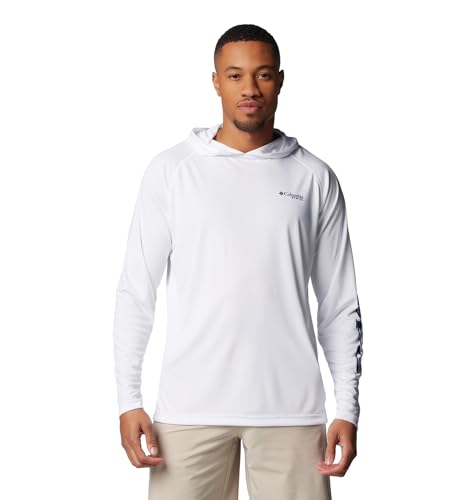
A second example is the Columbia Terminal Tackle hoodie listing. It offers another identifiable hooded format to investigate without assuming that all hood shapes are equivalent. Compare the selected Terminal Tackle hoodie on Amazon with the headwear and layer arrangement you have already worked through.
Browse the hooded shirt collection if you want to compare attached options, or return to our buying guides for other design decisions. The useful result is a neck-and-headwear setup you understand: comfortable while moving, acceptable with the hood lowered, and consistent with the coverage you intend to use.
Frequently asked questions
Can I wear a fishing hoodie over a baseball cap?
Some combinations work comfortably, but fit varies. Try the hood with your actual cap, turn your head and look down to check the opening, neck pressure and movement.
Does a hooded shirt protect the whole face?
Do not assume it does. A hood covers only the areas it actually reaches in use, and its opening can shift. Verify any stated fabric rating separately from garment coverage.
Why does my hoodie feel tight when I cast?
The cause may involve the shoulders, sleeves, hood or their interaction. Compare the movement with the hood up and down, then check the cut rather than automatically choosing a larger size.
Final Verdict
Choose a hoodie when an attached covering is part of the outfit you want and its shape works with your cap, movements and other layers. Choose a crew when you prefer a simpler neck area or independent headwear choices. The Pursuit examples show why even a same-family comparison needs exact specifications; the Terminal Tackle hoodie adds another shape to investigate. Give the hood-down position a proper fitting, and do not mistake an attached hood for complete coverage. A comfortable arrangement you will use consistently is the practical goal of this comparison.
Explore the matching collections
Take the next step
Compare your shortlist or explore more buying & comparisons.
Revisit the first shirt on Amazon ↗Related field notes
How to Read a Fishing Shirt's UPF Label
Read a fishing shirt’s UPF label with a clear checklist for model identity, rating conflicts, fabric panels, coverage, care, and seller details.
Read the field note →Columbia vs Huk Fishing Shirts: Compare the Shape Before the Logo
Compare Columbia and Huk fishing shirts across crews, hoodies and button-fronts, with clear guidance on fit, version differences and useful features.
Read the field note →Fishing Shirt Thumbholes: Hand Coverage, Sleeve Fit and Movement
Learn how fishing shirt thumbholes affect sleeve position and hand coverage, how to check wrist tension, and when an ordinary cuff may suit you better.
Read the field note →Fishing Shirts with Built-In Face Masks: What to Check
Check built-in fishing shirt masks for face coverage, head movement, eyewear fit and comfort, with clear distinctions between hoods, gaiters and masks.
Read the field note →