BASSDASH
Men's Performance Long Sleeve Tee
Long sleeve · Listed UPF 50+
Details & considerationsView on Amazon ↗Choose comfortable layers under fishing waders with checks for bulk, sweat, shirt hems, socks, seams, and changing conditions from the walk to the water.
Wear smooth, comfortable layers under waders, adding insulation to suit the water, weather, and activity rather than the calendar alone. Avoid bulky seams, loaded pockets, and bunching at the waist or ankles. A simple long-sleeve top can fit neatly beneath the upper section; check the whole system by sitting, stepping, and bending. Keep a dry change available, and remember that waders do not replace appropriate flotation or other safety equipment.
As an Amazon Associate I earn from qualifying purchases. These links take you to Amazon, where purchases take place.
Examples for this guide. Check the exact garment and variation on Amazon.
Under-wader clothing works within a limited space. A comfortable shirt and trousers can become awkward when their hems, pockets, and seams are enclosed under another garment. Start by thinking about the contact points: waist, knees, ankles, shoulders, and the upper edge of the waders. Your goal is an arrangement that stays smooth during ordinary movement, not a collection of the warmest individual items you own.
Read the wader manufacturer's fitting and use instructions before assembling the layers. The amount of clothing that fits comfortably depends on the waders and your body, not just the size printed on your trousers. This guide concerns the layers you wear inside; it does not rank waders or boots, and it does not replace guidance for the conditions where you intend to fish.
Lay out the base clothing, any insulation, socks, and shirt together. Empty pockets and remove any hard object that could be trapped against the inside of the waders. It is easy to forget a key, folded tool, or thick wallet until pressure reveals it during a long session. A clean starting layout makes those small problems obvious before you put the outer garment on.
A smooth base layer gives you a consistent starting point. Choose clothing that is comfortable next to skin and does not rely on a stiff belt or bulky drawcord knot. Check the fabric's care and intended use rather than assuming all leggings or all athletic trousers behave identically. A close fit can help prevent folds, but tightness that restricts movement is not useful simply because it reduces visible bulk.
For the top, a simple crew neck often makes the upper-body system easier to arrange. It has no hood to trap beneath a collar and may avoid the bulk of a button placket. That is a practical format preference, not a rule against button-fronts or hoodies. If you like either, test the actual garment with your waders and outerwear and judge the contact points.
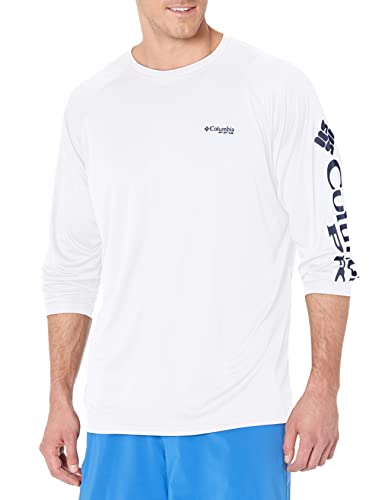
The BASSDASH long-sleeve performance tee and Columbia Terminal Tackle long sleeve illustrate simple crew-style tops to assess. The first listing states UPF 50+; the selected Terminal Tackle title does not establish a numerical rating. Neither title alone proves how warm or comfortable the shirt will feel inside your particular wader system.
Ask how much walking comes before fishing, how long you expect to remain relatively still, and what conditions are expected during both periods. A strenuous approach followed by a quiet stretch at the water creates different clothing demands from a short walk and constant movement. The date can suggest what to check, but it cannot select the exact layer count on its own.
| Session pattern | Layering question | Adjustment to consider |
|---|---|---|
| Long approach before fishing | Will the starting outfit feel excessive while walking? | Keep an addable layer accessible for the transition |
| Extended stationary fishing | Is there adequate appropriate insulation once movement slows? | Plan the fishing phase separately from the approach |
| Variable weather | Can the upper layers be changed without rearranging everything? | Use a simple base and accessible outer layers |
| Warm air with cold water | Are you considering water conditions as well as the air? | Seek local guidance and avoid an air-only decision |
| Unfamiliar location | What do the guide and manufacturer recommend? | Resolve the uncertainty before the trip |
There is no universal temperature chart that can guarantee the right outfit for every angler. Duration, activity, fit, and exposure all influence the decision. If you are unsure about cold-water preparation, get advice for the location and activity rather than trying to solve it with an extra shirt. The clothing inside waders is only one part of a suitable overall plan.
When adding insulation, choose a layer that fits beneath the waders without making knees and hips feel bound. Test one purposeful layer before stacking several ordinary garments with overlapping waistbands. Extra fabric can create pressure and make movement cumbersome. A bulky trouser seam pressed against the leg is a fit problem even when the fabric itself feels soft.
Jeans can introduce thick seams, rigid waistbands, and pocket hardware into the enclosed space. Those details are reasons to choose something smoother for under-wader use. Simms' size and fit guidance explicitly advises against jeans under waders. Follow the instructions for your own equipment, and do not use familiar everyday trousers as the default merely because they are already on when you leave home.
The same scrutiny applies to cargo trousers and heavy sweatpants. The issue is not their category name alone; inspect the actual bulk at the knees, seat, pockets, and cuffs. A thick cuff that seems harmless outside waders can fold against the ankle. A large pocket flap may sit exactly where another layer presses. Pick clothing for the inside environment rather than judging it only as standalone streetwear.
Put on the base clothing and smooth the shirt around your waist. Avoid leaving it rolled into a ridge above the waistband. If tucking the shirt keeps it in position, distribute the fabric evenly instead of gathering it at the back. If it is worn untucked inside the waders, check that the hem lies flat and does not get caught when you pull the upper section into place.
Raise your arms and bend forward after arranging it. A shirt that immediately pulls free or bunches may need a different length or fit. Do not compensate by stretching the fabric tight across your torso. The shirt should allow the movement without making you reset the hem after each cast. Our shirt-sizing guide covers the broader fit decision when an existing top repeatedly fails this check.
For a simple layer to inspect, the Terminal Tackle long-sleeve listing on Amazon identifies the exact example used here. Check its selected size, hem shape, and care information. Do not infer a thermal rating from the fishing-shirt name; this recommendation concerns its uncomplicated crew form as a candidate for a fitting trial.
If your top has pockets, leave hard or bulky items elsewhere when they would be enclosed under the wader bib or straps. Test any pocket you intend to use with the whole outfit on. If retrieving something means loosening several layers, the pocket may not be useful during the session. Move frequently needed items to the appropriate accessible storage in your overall setup.
Follow the wader and footwear manufacturer's fit guidance for socks. More pairs are not automatically better if they crowd the available space or create folds. Check that toes can move comfortably and that the sock is smooth around the heel. Keep lower-leg clothing arranged so a cuff does not double over into a thick band at the ankle.
After putting the full system on, walk a few steps and bend the knees. If a fold forms, fix it before you leave the fitting area. Repeatedly tolerating a small lump is not a useful test of toughness; it is a sign that the clothing arrangement needs attention. Try a different cuff position or a less bulky layer rather than forcing the footwear tighter to hold everything still.
Do not improvise cutting or altering an inner cuff just before the trip unless you understand how that garment is constructed. A loose raw edge can introduce another bunching problem. If a layer consistently fits poorly at the ankle, choose a better-suited garment for next time and keep alterations as a separate, considered task.
This rehearsal does not simulate every condition at the water, but it can reveal basic incompatibilities. If the outfit is uncomfortable in a calm fitting check, expect to resolve it before fishing rather than assuming the waders will stretch around it. Keep a note of what changed when you added each layer; that makes the source of restriction easier to identify.
Pack a dry change in appropriate storage, including the lower-body items you are likely to need. A spare top alone may not be enough if the clothing inside the waders becomes damp. Keep the change separate from used socks and wet equipment. Arrange it where you can reach it at the end of the session without emptying the entire fishing bag onto the ground.
If your layers repeatedly become damp, consider the sequence of activity and clothing adjustments, and inspect the waders according to the manufacturer's guidance. Do not assume every damp area proves a leak, or that every damp area is only perspiration. Record where it appears and when, then investigate the actual problem. More insulation is not a universal solution to unexplained wetness.
The BASSDASH crew listing on Amazon is another top to compare if you need a simple spare. Browse long-sleeve shirts for the layer format, keeping under-wader bulk and fit central. For the complete outfit beyond the waders, read what to wear fly fishing and the on-the-water guides.
Afterward, separate the clothing from the waders and dry each according to its own care instructions. Leaving the entire system bundled together makes it harder to inspect or dry the individual pieces. A smooth, clean set of layers ready for the next outing is a better result than a damp pile that must be untangled at the next early start.
They are a poor default because of bulk, seams, and hardware; Simms specifically advises against them. Choose smoother layers and follow your own wader maker’s instructions.
Use the arrangement that keeps the hem smooth during reaching and bending. Avoid a gathered ridge at the waist, whether tucked or untucked.
Not necessarily. Additional pairs can crowd the footwear and create folds. Follow the equipment’s fit guidance and check comfort through walking and bending.
Under-wader clothing works best as a smooth, considered system. Start with comfortable base layers, add appropriate insulation for the session, and remove unnecessary bulk at pockets, waistbands, and cuffs. Rehearse sitting, stepping, and casting before committing to the outfit. A straightforward crew shirt can be a useful upper layer, but its fit inside the complete setup matters more than the fishing label. Keep a dry change available and investigate recurring dampness instead of guessing at its cause. The aim is clothing that stays arranged and lets you move without repeatedly fixing hidden folds.
Compare your shortlist or explore more on the water.
Revisit the first shirt on Amazon ↗Choose a fly-fishing outfit for bank fishing, wading, or a boat, with practical checks for casting, line management, sun coverage, packs, and layers.
Read the field note →Build a fishing shirt layering system that moves freely, handles changing conditions, and keeps collars, hoods, cuffs, and pockets easy to use.
Read the field note →Find better value in fishing shirts by comparing useful features, fit, purchase terms and care, without relying on temporary prices or discount claims.
Read the field note →Plan kayak-fishing clothing around water exposure, seated movement, life-jacket contact, sleeve reach, and dry storage, with practical shirt-fit checks.
Read the field note →